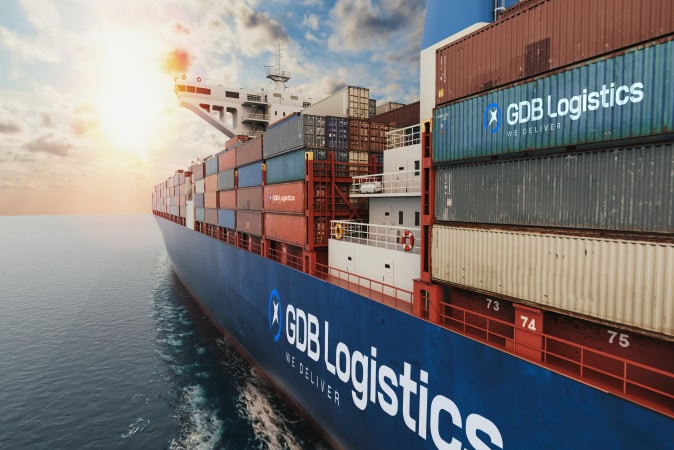
“Our work begins with sourcing containers for our customers,” Christa says. “Each week we handle hundreds of containers on average. We take care of the bookings in countries like China and manage the logistics all the way to the port in Europe. Once a container is at sea, it becomes visible in our system and we can track it. When everything goes smoothly and the container is unloaded, we schedule a delivery appointment with the customer. A stopover at one of our warehouses in Europe — from where we can handle the distribution — is also an option.”
From A to Z
Christa continues: “But of course, getting those containers here requires some intermediate steps. For example, we arrange the releases — these are needed to collect the containers. And securing those releases can sometimes be a challenge. We request them from the shipping lines, but sometimes information from the shipper is still missing. So we act as the intermediary. We work with a system that allows us to view the status of every shipment at a glance. That’s important, because only when all links are green can we move forward. It can be stressful at times, but by taking care of all these things, our customer doesn’t have to worry about anything. And that’s ultimately what we do it for.”
Flexibility thanks to our own transport
Thom adds: “Of course, sometimes transport doesn’t go as smoothly, and delays occur. Think of unexpected situations like a grounded vessel, severe weather, or an extra customs check. We can’t control that. But we can influence what happens afterwards. It helps enormously that we have our own fleet of trucks. We can see when the container — even if delayed — will be delivered. If the customer has an urgent need, which happens regularly, we immediately coordinate with the operational department of De Boer Transport to see if we can deploy trucks for onward transport to the destination. That way, we can still respond flexibly to the customer’s needs.”
Open communication
That the work is diverse, Thom confirms without hesitation. “You can plan and define everything as well as you like, but there’s always a chance something unexpected will happen. But that’s what makes it dynamic. And by now, we’ve gained a lot of experience, so we’re not easily thrown off by sudden changes. We know the mornings are often hectic and the afternoons a bit calmer. With our team of eight colleagues and the operational departments at De Boer Transport and Warehousing, we can handle a lot. The most important thing is to keep customers well informed, clearly and consistently. That’s essential for a good partnership.”
Continuous improvements for even better insight
That GDB Logistics has its planning and logistics well organised doesn’t mean the department stands still. “We work with a custom-built system that can integrate well with the customer’s systems and with, for example, customs,” Christa says. “We now operate in several countries and also handle exports. It’s important that we can connect as many systems as possible. With our current system we already have strong visibility, but we’re continuously working to improve it further and integrate with additional partners. The better our insight, the more accurately we can predict — and that ultimately benefits our customers.”
Vendor management
“And we even take it a step further,” Thom adds. “If the customer tells us when their goods need to arrive at the store or our warehouse, we plan the entire process. We can even plan back to the moment their supplier needs to have the goods ready for loading and shipping to Europe. We simply understand the supply chain very well — both in general and for each customer specifically.” Christa adds: “We then monitor our customers’ suppliers on their logistics performance. We call this vendor management. We’re noticing that customers increasingly need this service, so we take on that part for them as well.”